
The initial NET rankings for the 2023-24 season are available. What are some notable takeaways from the starting point of the rankings?
With every team now several games into the 2023-24 college basketball season, the NCAA released its initial NET rankings for the campaign. It might seem a little early to be having bracketology conversations, but on the other hand, games played in November matter just as much to the NCAA Tournament selection committee as those played in February.
The first batch of NET rankings always come with their flaws. After all, there are limited data points from which to draw rankings. As more data points — aka final scores — arrive in the coming weeks and months, the NET will paint a clearer picture of who the best teams in the country are.
Even with the limited sample size, the initial NET rankings serve as a baseline for the rest of the year. With that in mind, here are some key bracketology-related takeaways from the rankings.
More from Heat Check CBB:
1. “Overachieving” teams are rewarded with high ranks
Early-season rankings on top analytics sites (KenPom, BPI, EvanMiya, Bart Torvik, Haslametrics, etc.) are great for understanding the general college basketball landscape. Still, many feature preseason baselines that take at least the first month or two to be phased out. Those baselines sometimes hold back the rankings for teams that exceed preseason analytic expectations right out of the gate, That makes it challenging to determine where an “overachieving” team truly falls among its peers. The NET, which does not include a preseason component, makes the situation more straightforward.
The chart below displays the 15 teams that have improved their adjusted efficiency margin most on KenPom since the season’s opening tip. Compare the movement from the end of last season to the first rankings of 2023-24:
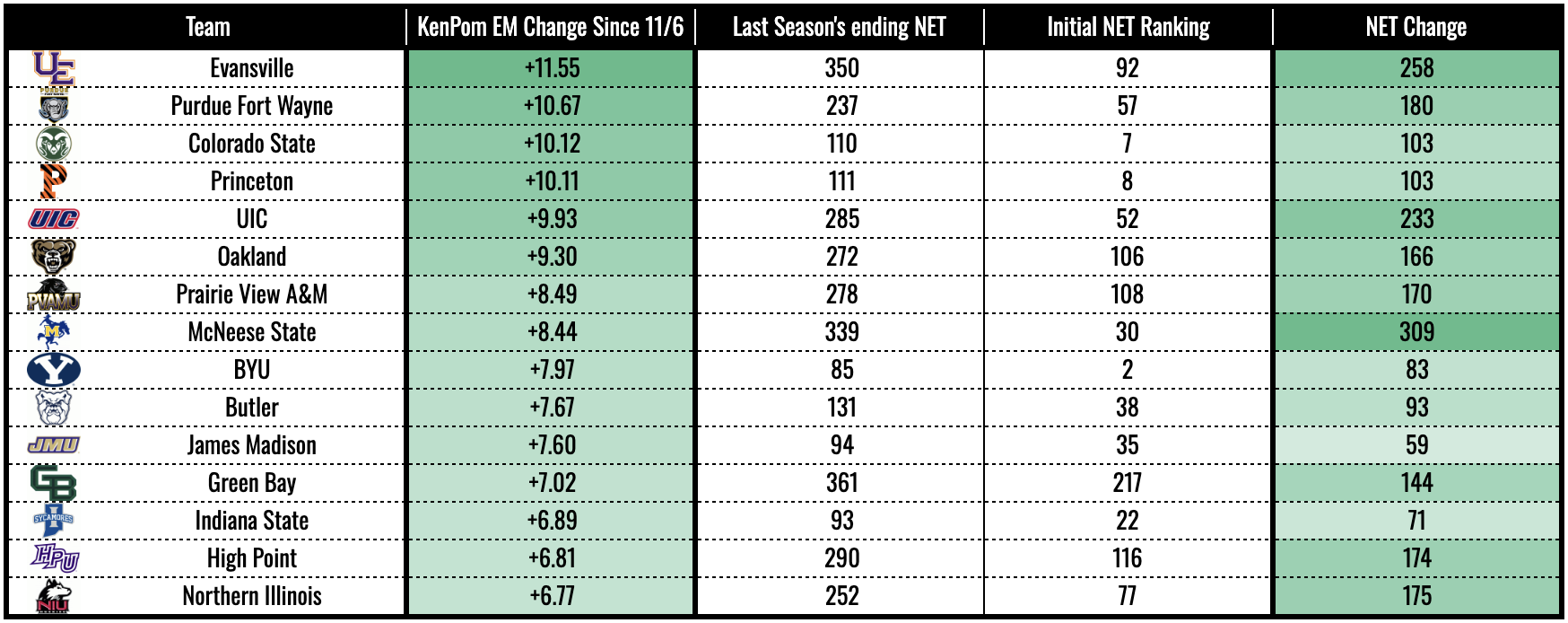
All of the “overachievers” have made significant gains in the NET compared to the end of last season. This is important because it is an actual starting point for those teams hoping to compete for at-large bids. Colorado State, BYU and Butler, for instance, can see their early-season performance reflected in the NET without being anchored by any other information. It is positive news for all three — and the others on this list — that they are held in higher regard by the NET than by KenPom’s current rankings.
2. Big 12 and Big East dominate the top of the rankings
Eight of the top 11 high-majors in the initial NET rankings come from the Big 12 or the Big East — and that doesn’t even account for Kansas, which somehow slipped to No. 16.
- No. 1 Houston (Big 12)
- No. 2 BYU (Big 12)
- No. 4 Creighton (Big East)
- No. 6 Baylor (Big 12)
- No. 9 UConn (Big East)
- No. 10 Marquette (Big East)
- No. 13 Iowa State (Big 12)
- No. 14 Cincinnati (Big 12)
Of course, each of those teams will be happy to be highly-regarded in early December. However, the NET is first and foremost a sorting tool for determining the quadrant records that will soon dominate bracketology conversations. As such, these high marks for the Big 12 and Big East are perhaps more notable to the teams ranked somewhere in the middle of those leagues.
Tournament hopefuls like Texas, Texas Tech, Providence and St. John’s — among others — opened with sub-50 rankings in the NET. Each program will have the benefit of several top-tier, resume-boosting opportunities throughout their conference schedules.
3. Mountain West thriving at the top
Perhaps the biggest winner from the NET’s debut was the Mountain West. Even with Boise State (No. 126) off to a poor start this season, other schools are stepping up. San Diego State is ranked in the top 40 after its trip to the national title game last year, but the Aztecs are just one of five MW teams to meet that criteria:
- No. 7 Colorado State
- No. 21 Nevada
- No. 24 San Diego State
- No. 34 Utah State
- No. 36 New Mexico
The quality of the league falls off quickly after the top five (Air Force is next at No. 118), but the top breeds optimism for another multi-bid season. When the first NET rankings came out last season, the Mountain West’s top five averaged a ranking of 34.8, and the league eventually earned four bids to the Big Dance. This year, the average rank for the top five is 24.4. Can the MWC repeat a big postseason?
4. Road wins carry immense early value
Looking at the teams that appear to be overvalued in the initial NET rankings, early road wins stand out as a trend. Princeton, for instance, is No. 8 in the rankings on the back of an 8-0 record that already includes five road wins. The Tigers are the only team in the country to have played at least three true road games without losing any. UMass Lowell (No. 46) cracks the top 50 with a 4-2 road record to its name. Cornell (No. 55), is another well-regarded Ivy team with a trio of road wins.
It shouldn’t come as a surprise that the model values road wins. But with so few games on everyone’s resume — and with so many being buy games, where road wins are most improbable — they mean even more to the algorithm at this point. Expect to see some high-majors rising in the coming months as they start picking up some road wins instead of playing the majority of games at home.
5. Seven preseason AP Top 25 teams falling quickly in NET
The NET eliminates all of the preseason bias that impacts both human polls and efficiency-based analytics sites with baked-in preseason statistics. That is extremely evident when it comes to analyzing the biggest early-season disappointments. Saint Mary’s, for instance, entered this season as an AP Top 25 team; however, a 2-5 start has the Gaels at just No. 155 in the NET. (For comparison, KenPom still has them at No. 65.)
Saint Mary’s is one of seven preseason Top 25 teams that did not debut in the top 50 of the NET. The NCAA’s sorting tool is not nearly as forgiving to teams with poor starts as KenPom has been:
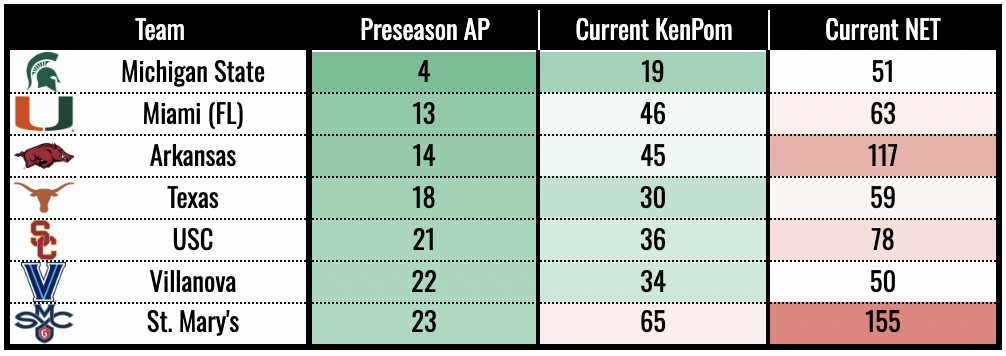
It is extremely early and there is a ton of time remaining to build stronger resumes, but the initial NET makes it clear that those seven “underachieving” teams have work to do.
6. The big leagues each have at least one big “landmine”
The initial NET rankings for the season painted an early picture of what some of the best wins in the country could be this season. For instance, the Big 12 and Big East featuring eight of the top 11 high-major teams bodes well for the fringe NCAA Tournament contenders in those leagues. Conversely, the rankings also revealed what some of the biggest “landmine” games could be in the high-major ranks.
As a bracketologist, I define “landmine” games as when an NCAA Tournament contender faces off against a lower-rated opponent in a game that can only hurt their resume. A win would not boost a team’s standing, while a loss could be catastrophic. As it stands, the top six conferences each feature at least one “landmine” team that opened with a sub-200 ranking in the NET:
- ACC: Notre Dame (No. 238), Louisville (No. 279)
- Big 12: West Virginia (No. 209)
- Big East: Georgetown (No. 221), DePaul (No. 267)
- Big Ten: Maryland (No. 210)
- Pac-12: Stanford (No. 211), Oregon State (No. 226), California (No. 251)
- SEC: Vanderbilt (No. 276)
It is still only early December, so all of the teams above will have opportunities to drastically improve their NET in the coming months. But for now, these are the potential “landmines” in high-major conference play.
7. Other specific rankings of note
No. 11 Florida Atlantic Owls
Everyone knows the Florida Atlantic story. The Owls made the Final Four last season and brought back the majority of their rotation for this year. Living up to high expectations could have derailed them early in the year, and it seemed like it might with a loss to Bryant, but the Owls have bounced back since. FAU is 7-1 and debuts near the NET top 10. Great start to the encore.
No. 13 Iowa State Cyclones
Iowa State is an example of using lower-level opponents to bolster its NET rankings. While the NET removed margin of victory as a standalone variable in 2020, teams can still derive a major efficiency boost from posting massive point differentials. ISU does not have a win over the NET top 130, and it has two losses. Still, the Cylones sit at No. 13 in the initial rankings. Four of their wins have been by 30 or more points, including two by 55.
No. 16 Kansas Jayhawks
The Jayhawks rank second in the most recent AP poll but slot at just 16th in the NET. How? Point differential might be the culprit. Kansas is 3-1 in four games against the NET top 45 but with a total point differential of +4. KU also only beat Eastern Illinois (No. 290) by eight, plus one of their blowouts is not factored into the NET as it came over a non-D1 opponent (Chaminade).
No. 26 Wisconsin Badgers
Wisconsin has won five straight, including victories over Virginia and Marquette. However, the Badgers are an example of how every game matters regardless of timing. Early double-digit losses to Tennessee and Providence — including one at home — still play a factor and drag down some of the quality from the top-tier wins. Beating Robert Morris (No. 302) by only 10 also contributes.
No. 35 James Madison Dukes
James Madison is 7-0 and nationally ranked. However, it was not a given that the Dukes would be rated highly by the NET. After all, they are only No. 80 on KenPom. It is thus a very good sign for JMU — and the Sun Belt — that the team landed in the top 40. The NET appreciates the win over Michigan State but also several mid-tier wins such as those over Kent State and Southern Illinois.
No. 56 Drake Bulldogs
Drake felt like a dark-horse at-large contender coming into this season. And while the Bulldogs have not wowed anyone in their 7-1 start — they even lost to Stephen F. Austin by 24 — they are still held in relatively high regard by the NET. A No. 56 start keeps them in the conversation before the thick of the MVC schedule, especially with a neutral-site matchup with Nevada (No. 21) looming.
No. 61 Providence Friars
Providence is 7-1 with a win over Wisconsin to its name. The Friars are also held in high regard by KenPom, rising to No. 44 after starting at No. 54. The NET is not as impressed, however, perhaps because of some missed opportunities to run up the score against lower-rated teams. The Friars beat Milwaukee (No. 335) by 10 and Lehigh (No. 311) by 14, both at home. Additionally, while the win over Wisconsin is great, it is Providence’s only win over the NET top 140. The team is also yet to play a true road game.
No. 87 Texas Tech, No. 89 Michigan, No. 100 Kansas State, and No. 103 UCLA
None of these teams were featured in the preseason AP poll, but their initial NET rankings are worse than they would have hoped at the beginning of the year. With each slotting in at 87th or worse, they are behind the eight ball for at-large bids after the opening month of the season. There is, of course, a lot of time left — but it can be a slow climb back toward the top, so these teams can’t afford to waste much more daylight.
You must be logged in to post a comment.