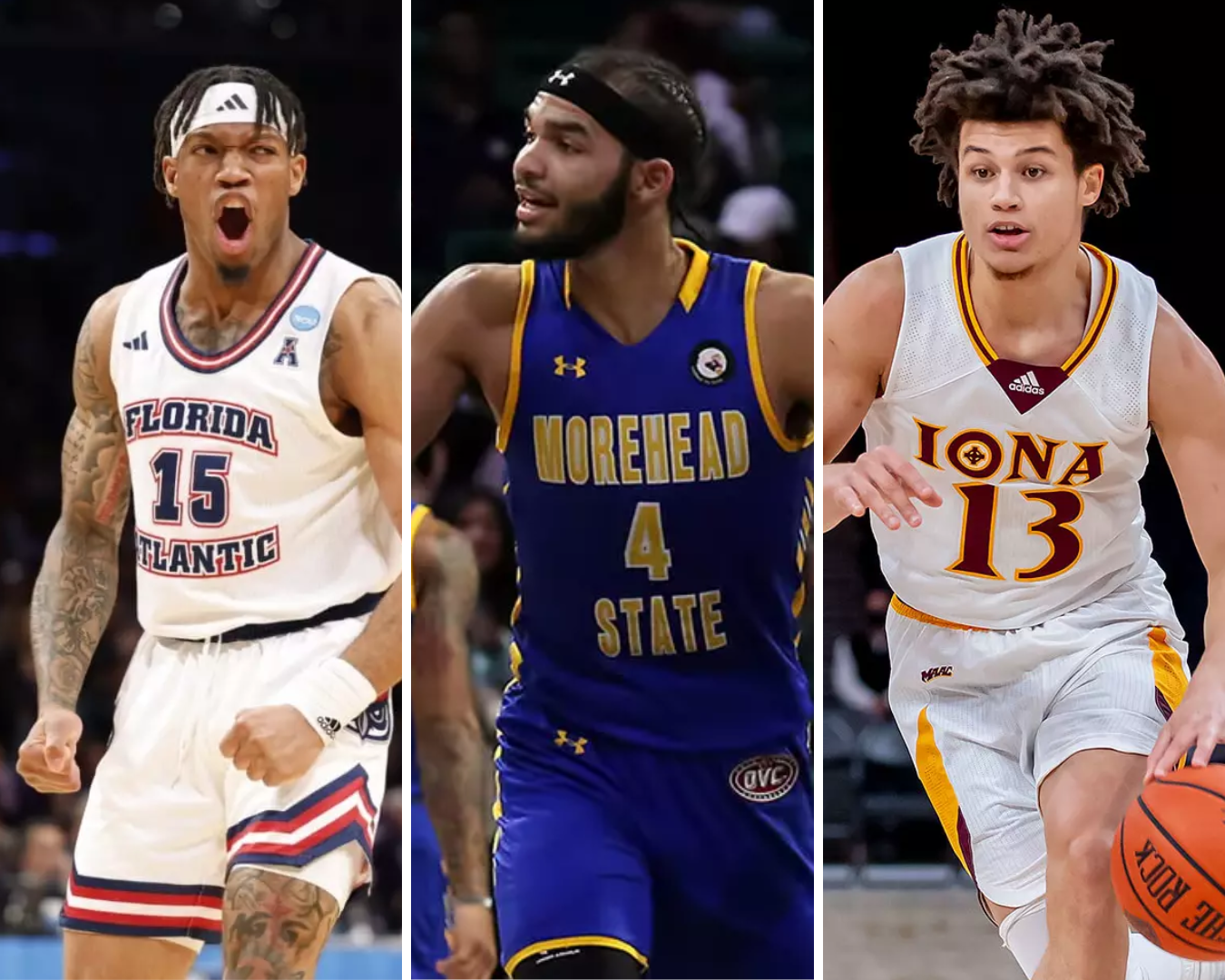
Players such as Auburn’s Johni Broome and Florida’s Walter Clayton Jr. are having their star moment in San Antonio after relatively humble beginnings to their college careers.
The overwhelming discourse in San Antonio at the 2025 men’s Final Four is the dominance of the sport’s powers. Unlike recent parity-laden tournaments, this year’s bracket has produced anything but madness: four 1-seeds remain, zero mid-major leagues were represented in the Sweet 16, and No. 3 Texas Tech was the lowest-seeded team in the Elite Eight.
Given the state of college sports in the 2020s, many have questioned whether this is a sign of the future. Have realignment, NIL and the transfer portal truly quieted the unpredictability of the March Madness?
Coaches aren’t so sure.
“I think we have to be careful,” Duke head coach Jon Scheyer said Friday, warning onlookers not to assume future Final Fours will be chock full of No. 1 seeds just because this one is. It’s a fair point, especially considering the national semifinals have fielded four No. 1s just one other time, in 2008.
What, then, might this Final Four tell us about the state of college basketball in 2025? Well, rather than looking at the front of each team’s jerseys, let’s focus on the names on the back of them.
Outside of Duke star freshman Cooper Flagg, Auburn’s Johni Broome is the most recognizable name left in the Big Dance. Unlike Flagg, though, Broome didn’t have NBA pedigree coming out of high school. Ranked 471st in his recruiting class per 247 Sports, the Plant City, Florida, native committed to Morehead State over Florida Atlantic, Georgia Southern, Jacksonville and Bryant.
But Broome’s story, unique as it is, isn’t the only instance of unheralded recruits becoming household Final Four names in 2025.
Take Walter Clayton Jr., who has willed Florida to its first Final Four since 2014 with countless clutch March moments. A two-sport star, Clayton received SEC football interest out of high school — but his basketball scholarship offers weren’t exactly blue bloods. He eventually committed to Iona amid offers from East Carolina, Florida A&M, Charleston, Stetson and James Madison. Like Broome, Clayton gradually developed from a low-major prospect into a consensus All-American competing for a national title.
Clayton’s teammate, Alijah Martin, has a similar background. Another multi-sport athlete, Martin threw for 20 touchdowns his senior season of high school before committing to Florida Atlantic’s men’s basketball program over Southern Miss and Tulane. This will be Martin’s second Final Four appearance after he led FAU to a memorable run in 2023. Reaching multiple Final Fours is a feat that even the most critically acclaimed prospects rarely match.
“The similarities I see (between the two Final Four runs) is the bond throughout the team,” Martin told Heat Check CBB. “The difference is the relationship part. Most of these guys (at Florida) have been around each other for one or two years. At FAU, we were together for three or four years. It’s different relationship-wise, but both teams are deep, skilled defensively and offensively.”
Unheralded recruits to Final Four contributors
| Player | 2024-25 Stats | Previous School(s) | Recruiting Profile (247 Sports) |
| Johni Broome, Auburn | 18.7 PPG, 10.9 RPG | Morehead State | 3-star; No. 471 |
| Walter Clayton, Florida | 18.1 PPG, 38.5 3P% | Iona | Unranked |
| Alijah Martin, Florida | 14.5 PPG, 35.0 3P% | Florida Atlantic | Unranked |
| Chad Baker-Mazara, Auburn | 12.2 PPG, 37.2 3P% | Duquesne, San Diego State, NW Florida State | Unranked |
| Will Richard, Florida | 13.3 PPG, 35.7 3P% | Belmont | 3-star; No. 330 |
| Denver Jones, Auburn | 10.9 PPG, 41.8 3P% | Garden City CC, FIU | Unranked |
| Sion James, Duke | 8.7 PPG, 3.0 APG | Tulane | 3-star; No. 437 |
| Chaney Johnson, Auburn | 9.2 PPG, 4.9 RPG | Alabama-Huntsville | Unranked |
| Micah Handlogten, Florida | 2.9 PPG, 76.0 FG% | Marshall | Unranked |
Both Pearl and Florida’s Todd Golden — competing Saturday for a spot in Monday’s national championship — have assembled rosters with once-overlooked recruits who earned their stripes outside of the SEC limelight.
“With the transfer legislation the way it is, those guys — I would say even for Walter and Johni, as 18-year-olds — would not be able to help an SEC program compete the same way anywhere close to what they do now,” Golden said.
Of the 13 programs this season that rank top 65 nationally in experience and top 45 in roster continuity, per KenPom, three — Florida, Auburn and Houston — are in the Final Four. Five others reached the NCAA Tournament. Two more won at least 21 games.
“You look at a lot of the teams that have had success, they’re older,” Golden continued. “They have senior-laden rosters, guys that are 23, 24, even 25. A lot of times it takes getting a little older for those guys to really be able to impact at a high, high level.”
Pearl, meanwhile, spoke to the gratitude of small-college transfers who reap the benefits of their patience.
“When you get a guy that is overlooked and you spoil him, he’s more appreciative and grateful for the opportunity,” Pearl said. “He goes to work every single day trying to prove people wrong.”
What better way to prove people wrong than in the Final Four, especially after receiving little to no recruiting interest? Sure, it would be impossible to mistake this year’s Final Four quartet for a Cinderella story. But given where many of these eventual stars began their careers, the odds stacked against them reaching this stage is undeniable.
Perhaps it’s time to look beyond seed lines and conference affiliations, and instead focus on the individual players whose hard-fought journeys have brought them to the sport’s biggest stage.