
Another new era is on the horizon for Indiana basketball. While the Hoosiers remain a premier brand, they have appeared in just two of the last six NCAA Tournaments.
Failing to earn a ticket to the NCAA Tournament the past two seasons led Indiana to fire Mike Woodson, and the task of reinvigorating the storied program now falls on the shoulders of Darian DeVries. The former Drake and West Virginia head coach wasted little time setting up his initial roster, too. DeVries landed 10 transfers in his first month and a half on the job.
The Hoosiers’ transfer class is a mixed bag depending on which lens you view it through. From a pure incoming talent standpoint, 247Sports rates IU’s class in the top 10. When accounting for both incoming and outgoing transfers, though, EvanMiya grades IU’s overall transfer activity at 320th in the country. Losing players such as Malik Reneau, Mackenzie Mgbako and Myles Rice are significant blows.
Indiana’s roster isn’t the only thing that will be new, though.
DeVries adjusts to fit his personnel as all coaches do, but he has maintained some statistical trends across his seven seasons as a head coach — many of which differ from IU’s recent past. Let’s dive into how the new Hoosiers fit with DeVries’ style on paper.
The 3-point revolution heads to Bloomington
It doesn’t take long to decipher Indiana is entering a new stylistic era. DeVries’ teams have finished top-110 in either 3-point percentage or 3-point attempt rate in six of his seven years as a head coach. Meanwhile, Indiana has finished top-110 in 3-point shooting just once since 2017, and never top-250 in attempt rate over that stretch.
Devries-coached teams have shot at least 35% from three in 122 of his 237 games coached, going 104-18 in those games — a far cry from the 75-50 mark they’ve put up when failing to do so. The prioritization of the 3-point line was evident in DeVries’ roster-building as well. Of the 10 newcomers, nine made at least 10 threes last season, and four of them did so on 39% shooting or better:

Sam Houston transfer Lamar Wilkerson (202-for-505, 40%) and Darian’s son Tucker DeVries (276-for-752, 36.7%), most notably, are two of the nation’s most prolific shooters. With respective averages of 20.5 and 21.6 points per game during their last full seasons, Wilkerson and DeVries are the frontrunners to lead Indiana’s offense next season. The coach’s kid has All-Big Ten potential in his final season of eligibility after playing only eight games at WVU last year.
Schematically, forwards/bigs Reed Bailey (Davidson), Josh Harris (North Florida) and Sam Alexis (Florida) are extremely notable additions as floor-stretchers. Bailey and Harris both shot effectively on reasonable 3-point attempts this season, while Alexis was 30-for-105 (28.6%) over two seasons at Chattanooga before taking a step back in volume and efficiency this past season.
All three still attempt more of their shots inside the arc than out, but defenses have to respect them from distance. That creates space for drivers.
A familiar face set to spray to shooters
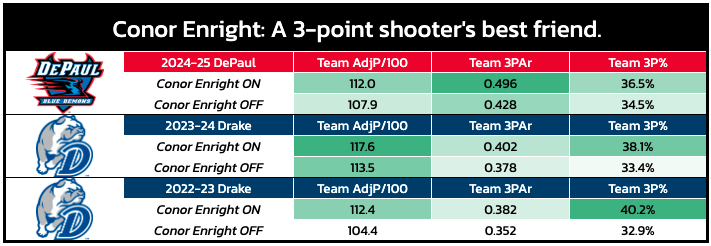
While Conor Enright did not follow Darian DeVries to West Virginia last season, instead staying in the Midwest and attending DePaul, he was a two-year starter at Drake under the new Hoosier skipper. During that time, Enright averaged 5.5 points and 2.4 assists, notably forming a superb connection with the younger DeVries. The Bulldogs were 8.7 adjusted points per 100 possessions better with Enright and Tucker DeVries sharing the floor in 2023-24 than when one or both sat.
Upon heading to DePaul last season, Enright picked up where he left off from a creation standpoint — and then some. He upped his individual averages to 7.5 points and 6.2 assists, bettering DePaul’s offensive output by 4.1 adjusted points per 100 possessions he was on the floor compared to without, in part because the Blue Demons attempted more 3s and hit them at a higher rate. Not many playmakers in the country have a better track record at setting up 3-point shooters:
Elon transfer Nick Dorn should be an especially important benefactor to Enright’s creation. A true specialist, Dorn attempted nearly 75% of his field goals from beyond the arc last season. He ranked in the 75th percentile in catch-and-shoot efficiency, per Synergy, but just the 22nd percentile in off-the-dribble shooting. Further, fully 80 percent of his 74 made 3s came off assists.
Enright’s playmaking should also benefit fellow IU additions Jasai Miles (North Florida) and Jason Drake (Drexel). Both players made nearly a third of their 3-pointers unassisted last season. Drake, in particular, rated in the 88th percentile for catch-and-shoot efficiency.
What defensive identity will DeVries deploy?
Defensively, there are fewer trends to analyze. While DeVries has coached his teams to three consecutive top-75 adjusted defensive finishes, it manifested in very different ways. For instance, his last two teams at Drake ranked in the top-five nationally for defensive rebounding rate but sub-250 in block rate. The switch flipped at WVU, ranking just 237th in defensive rebounding rate while finishing 69th in swat rate.
The most consistent trend among Darian DeVries’ defenses has been that they limit assists; all seven of his teams have ranked in the top 110 nationally for assist rate allowed. His teams force opponents to beat them with self-creation. Enright and Tucker DeVries helped Drake rank 14th-best nationally in assist rate allowed two seasons ago; that’s not a bad place to start.
Steal rate isn’t always correlated with strong perimeter defense and limiting assists, but it worked for DeVries with West Virginia last year. The Mountaineers ranked 50th nationally in steal rate and 45th in assist rate allowed, thanks in part to the opportunistic duo of Sencire Harris and Javon Small.
DeVries prioritized a perimeter thief this offseason, as well, bringing in Troy’s Tayton Conerway. The 6-3 guard not only led the Trojans’ NCAA Tournament team in scoring this past season, but he also posted the third-best individual steal rate in the country for a second consecutive year. Conerway recorded 15 steals in seven games against the KenPom top 100 this season. Thanks to those efforts, Troy was an astounding 24.5 adjusted points per 100 possessions better with Conerway on the floor.
Darian DeVries is already putting his stamp on the program
DeVries’ roster-building is a massive detour from Indiana’s usual construction. For the first time since 2008-09 — when IU went 6-25 — the Hoosiers will not feature a single former RSCI top-50 recruit. The top-rated recruit on the roster is incoming freshman Trent Sisley, a top-100 forward out of Montverde, but there are no five-star studs coming to campus. Instead, Indiana has been built around mid-major all-stars and experienced, proven collegiate contributors. On paper, they all fit within Darian DeVries’ scheme, and Tucker DeVries, Bailey and Wilkerson all have star potential.
That said, a lack of high-major track records is a question mark. Darian DeVries only has one season as a high-major coach under his belt, and he missed the NCAA Tournament (though that was considered a massive snub by many). As for his roster, only three of the 10 incoming transfers have any high-major experience — and all three began their careers at the mid-major level (Tucker DeVries, Enright, Alexis).
Can this deviation in roster-building and scheme lead to different results? IU has danced just twice since 2016, and with six of the 10 newcomers entering their final seasons of eligibility, this group has a short lifespan to jumpstart the Hoosiers’ resurgence on the national stage.
Darian DeVries has already put a rather unconventional stamp on the Indiana program. Time will tell whether this new approach yields more success, of course, but one thing seems clear: The Hoosiers will look quite different in 2025-26 under their new head coach.
You must be logged in to post a comment.