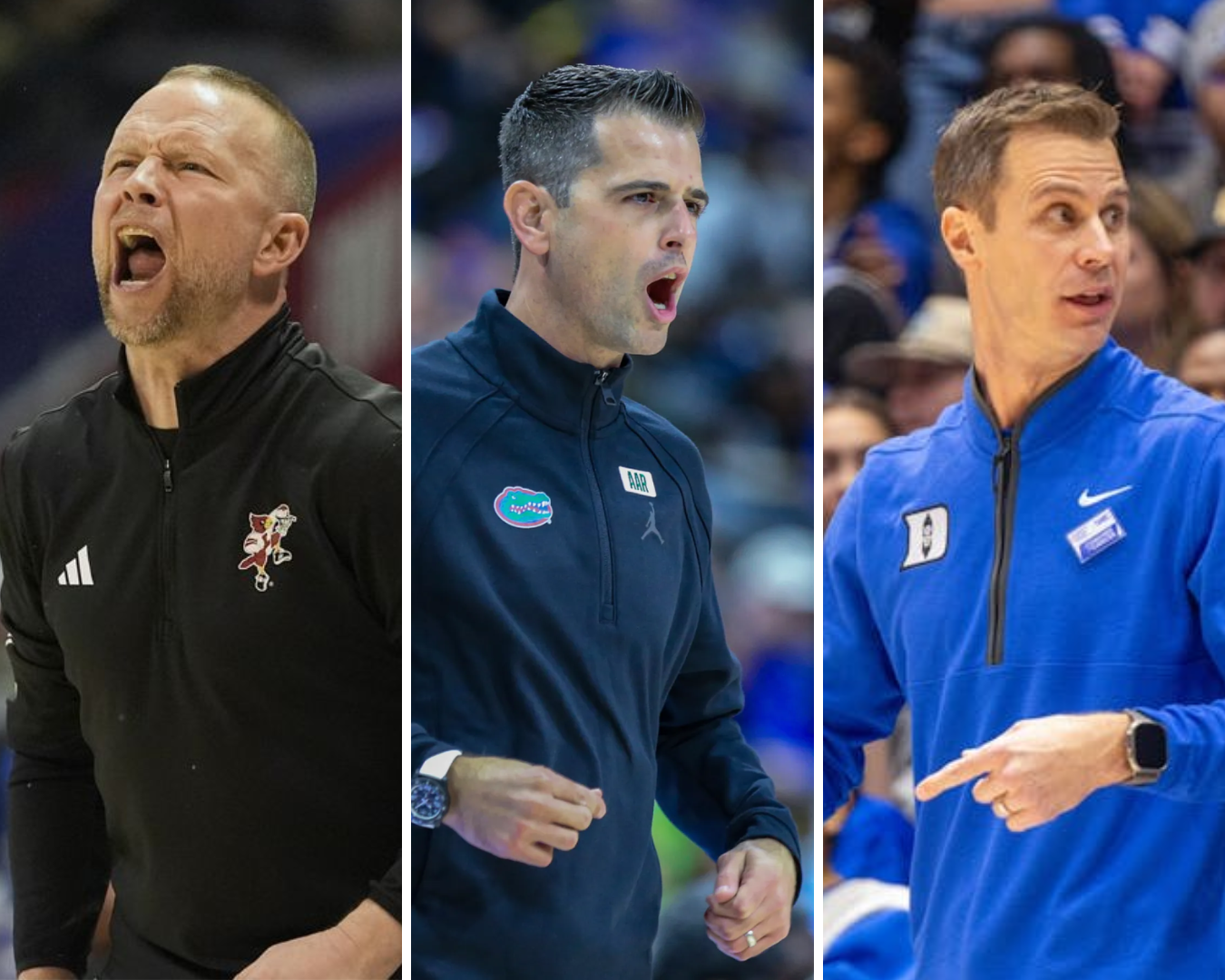
The modern NCAA basketball era is yielding more roster turnover than ever. What strategies have had the most success in recent years?
Rankings are at the core of sports discussion, and especially so in NCAA basketball. During the season, it is impossible to have a conversation without discussing the AP Poll, or KenPom, or the NET.
The offseason is not much different. Way-too-early top 25s for the following season drop within seconds of One Shining Moment airing. Coaching hires are graded with haste, and high-school star ratings have been supplemented in recent years by rankings for the top available transfers.
But which of those rankings mean the most? How often does a top coaching hire yield immediate results? What have been the outcomes for top recruiting classes? Or transfer classes? Those are crucial questions to look at when setting expectations for an upcoming campaign.
Taking into account three seasons of data for coaching hires via CBS Sports’ Candid Coaches rankings, transfer rankings via EvanMiya and recruiting rankings via 247Sports, let’s dive into how the various program-building strategies have fared.
Hire a highly-regarded new head coach
Hoping a highly-touted coaching hire can change the fortunes for your program? Well, you might be right. Over the last three seasons, none of the categories analyzed for this article have been more impactful than hiring a big name coach. Some haven’t panned out — Kenny Payne at Louisville — but those have been rare among the well-regarded hires. Of the 34 coaches to receive votes for “best hire” in CBS Sports’ Candid Coaches series over the last three years, 24 improved their program’s KenPom finish from the prior season — nine by 60+ spots.

Pat Kelsey and Dusty May, most notably, propelled Louisville and Michigan from sub-100 KenPom finishes to the NCAA Tournament. Chris Holtmann led DePaul from No. 304 to No. 122 in his first season last year. The 34 programs in question averaged a ranking of 103rd the year before hiring a new coach, and 75th after. Remove Payne’s disastrous first season, remedied two years later by hiring Kelsey, and those numbers show improvements from around 102nd to around 68th.
Notably, BYU and Duke were coming off top-20 finishes when they hired Kevin Young and Jon Scheyer after their predecessors vacated their posts; Young and Scheyer still finished top-30 each in their first campaigns, with the latter then finishing No. 1 in his second season.
Looking at just the top hires after firing a previous coach, 17 of those 21 replacements improved their program’s KenPom finish, averaging a first-year jump from around 130th to around 91st.
Programs to watch in 2026*: Indiana, Iowa, Minnesota, NC State, Texas, Villanova, Virginia
*CBS Sports has not released this season’s Candid Coaches yet. Programs to watch are based on other outlets ranking top coaching hires from the 2025 offseason.
Bring in a top transfer class
If you’re looking for the “perfect” recipe for an immediate bounce-back, follow in the footsteps of Louisville and West Virginia this past season. Those schools brought in highly-regarded coaches, Kelsey and Darian DeVries, who immediately secured top-rated transfer classes and ignited massive turnarounds.

Of the 30 top-10 transfer classes over the last three offseasons, seven were secured by Candid Coaches’ top-rated new hires. Six of those seven improved their new program’s finish from the year before, doing so by an average of 63.5 spots. Only Penn State’s Mike Rhoades took a step back, with his Nittany Lions dropping from No. 36 to No. 77 in his first year after a big transfer class.
As for new hires who secured top classes but were not among the Candid Coaches’ top hires, the results are erratic. West Virginia and LSU both fell over 100 spots from their previous seasons after Josh Eilert and Matt McMahon added strong classes, while Vanderbilt took a 135-spot leap under Mark Byington.
The only “middle ground” of the group was Florida’s Todd Golden, who fell 15 spots in Year 1 but won the national title in Year 3. Shrug.
New coaches with top-10 transfer classes in 2026: NC State, Iowa, Miami (FL)
Additionally, six more of the top-10 transfer classes over the last three offseasons belonged to coaches entering their second seasons. All of those programs took steps forward compared to their first seasons under that head coach, including Ole Miss’ Chris Beard (No. 86 to No. 22), St. John’s Rick Pitino (No. 21 to No. 14) and Texas Tech’s Grant McCasland (No. 31 to No. 9) making notable leaps after securing strong classes this past season alone.
Second-year coaches with top-10 transfer classes in 2026: Michigan, Kentucky, Washington, USC
As for the mainstays atop the coaching ranks, the 13 remaining top-10 transfer classes over the last three years were recruited by longstanding sideline generals (3+ years at their school). Nine of the 13 programs improved, including Creighton jumping from No. 50 to No. 12 with Baylor Scheierman and Francisco Farabello and North Carolina leaping from No. 43 to No. 9 with Harrison Ingram and Cormac Ryan.
Top-10 transfer classes secured by long-standing coaches in 2026: Florida, Tennessee, UCLA
Hope a top transfer is that last (or starring) piece
Not every program needs a complete offseason overhaul to take the next step. Sometimes, all it takes is one special transfer who can be a star in their role alongside a returning core.
It worked for Alabama when it jumped from No. 28 on KenPom to No. 4 in its first season with Mark Sears. The same can be said about Cam Spencer turning one championship into two for UConn. Tony Perkins (Missouri), Vlad Goldin (Michigan), and Robbie Avila (Saint Louis) were massive for their respective new programs last season.
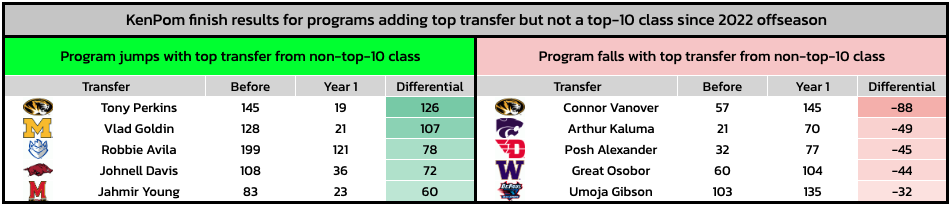
All that being said, there are a near-equal number of these situations that haven’t panned out for one reason or another. Of the 30 programs since 2022 that had a top transfer but not a top-10 class, there were more double-digit drops in the rankings than there were double-digit leaps. These situations are hit or miss, to say the least, given the varying circumstances surrounding each touted transfer. Evaluating these additions in the offseason requires much more nuance as to the roster around the incoming star.
Programs to watch in 2026: BYU (Robert Wright III), Georgetown (KJ Lewis), Kansas State (PJ Haggerty), Clemson (Nick Davidson), Louisville (Ryan Conwell), Arizona State (Moe Odum), Creighton (Owen Freeman), UConn (Silas Demary), St. John’s (Dillon Mitchell and Ian Jackson), Purdue (Oscar Cluff)
Land an elite high school recruiting class
While high school recruiting has taken somewhat of a backseat to the transfer portal in recent years, difference-making freshmen still enter the scene each year. Evaluating the strategy of piling up an elite recruiting class is difficult, though, when most of the programs at the top utilize the same path each year. Duke, for instance, secured a top-10 class in each of 2022, 2023, and 2024; the Blue Devils’ year-over-year results, in turn, are most influenced by the talent of a given class rather than the strategy itself.
For the programs that do not find always themselves among the top 10, though, one special group can create sky-high expectations but erratic results. Four* of the five largest year-over-year jumps thanks to adding a top-10 class come from programs with only one top-10 class in the last three years. Conversely, the three* largest year-over-year falls also fit that criteria:
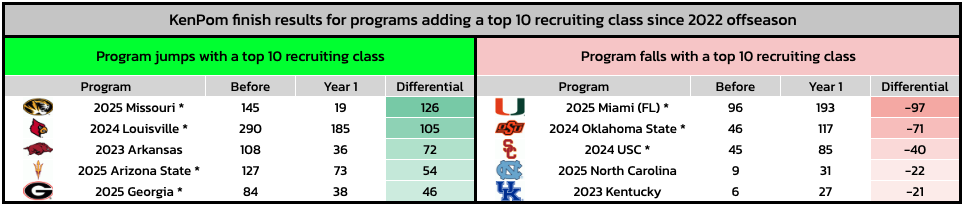
Diving a bit more into the details of top-10 classes from the past few seasons, the most notable teams to watch are those who finished on the cusp of elite the season prior. Seven of nine teams who finished between No. 10-30 on KenPom before adding a top-10 class took another leap forward with that group:

Programs to watch in 2026: Houston, Arizona, Notre Dame, SMU, Kansas (+ Duke, Alabama, Tennessee, UConn, Arkansas)
Land a top-rated recruit or two
Not every five-star recruit is part of a top class. However, programs hoping for just one or two recruits to solve its issues may have better luck next year. Of the best recruits from the last three seasons who were not part of a top-10 recruiting class, only 10 of the 30 led their team to a better finish from the prior year.

Looking at the situations that did work, many weren’t due to the star freshman. While solid contributors, Bryson Tucker and Kel’el Ware both came off the bench, and neither made their league’s All-Freshman team. Cody Williams stepped into a perfect supporting role next to stars KJ Simpson and Tristan Da Silva at Colorado, while Elliot Cadeau could say the same for RJ Davis and Armando Bacot.
Derik Queen is the anomaly. He wasn’t without help — Maryland featured four other double-digit scorers — but he was the leading scorer for a team that jumped 52 spots in KenPom.
As for the teams that struggled the most, their star freshmen were often thrust into tough situations. GG Jackson came in under a new coach on a South Carolina team that returned almost nothing. Aday Mara joined a UCLA program that had just lost four starters from a Final Four team. Mackenzie Mgbako was Indiana’s top addition after losing Trayce Jackson-Davis, a program legend in Bloomington.
The takeaway: A single top-rated recruit likely won’t propel dramatic improvement by himself. But if they can be a supplemental piece to players already set in star positions, big leaps can come.
You must be logged in to post a comment.