After beating Jacksonville State to earn an automatic bid, the Liberty Flames will represent Conference USA in the NCAA Tournament for the very first time.
When Liberty made the jump from the Atlantic Sun Conference to Conference USA, it was fair to wonder whether the Flames’ dominance would carry over. After all, Ritchie McKay led the program to at least a share of the regular-season title four times in the school’s five-year ASUN stint. The Flames also won three conference tournament titles, including in 2020 before March Madness was lost to COVID.
However, any concerns about Liberty’s ability to hang in CUSA have been silenced after just two years. The Flames limped out to a 7-9 league record in their debut campaign, but they turned that into a 13-5 mark this season — which was good for the regular-season crown and the top seed in the tournament. Once there, Liberty held court and beat UTEP, Kennesaw State and Jacksonville State to earn the league’s automatic bid.
The Flames have lost just once since Feb. 1, carrying a gaudy 28-6 record into the NCAA Tournament where they will be a popular pick to pull off a first-round upset. There’s certainly precedent for those hopes, considering Liberty knocked off Mississippi State as a 12-seed as recently as 2019.
More Heat Check CBB:
- Bracketology: Projected field | Bubble Watch
- Tournament Index: Complete March Madness projections
- Full conference tournament TV schedule
Liberty shoots better than any team in America
Three Liberty players earned All-CUSA honors this year, with second-team pick Kaden Metheny (13.5 ppg, 99 3PM) joining third-teamers Zach Cleveland (11.0 ppg, 6.3 rpg, 5.1 apg) and Taelon Peter (13.9 ppg). Peter also took home the Sixth Man of the Year award after leading Liberty in scoring — and leading the conference in field goal percentage at an eye-popping 76.1 percent — despite starting just two games.
Metheny and Peter spearhead Liberty’s customary 3-point barrage, which has led the Flames to top-25 national rankings for 3-point attempt rate in five consecutive seasons, per KenPom. Those aren’t empty numbers either — this team has the No. 1 effective field goal rate in all of Division I, as well as the fifth-best 3-point percentage.
The next 3-pointer Metheny knocks down will be his hundredth on the year, and while Peter is slightly behind in the raw count (75 3PM), he hits them at a 46 percent clip compared to 39 percent for Metheny. Meanwhile, point guard Colin Porter (54 3PM, 44.3 3P%) is also a key cog here, while forward Jayvon Maughmer (44 3PM, 32.8 3P%) can also hurt defenses from distance. The shots don’t stop when the starters sit, either.
In addition to Peter’s record-breaking performances off the bench — his three 30-point games are the most ever by a Liberty reserve — fellow substitutes Zander Yates (28 3PM, 41.2 3P%) and Brett Decker Jr. (21 3PM, 42.9 3P%) have made their presence felt at times. As a result, the Flames had the most prolific bench in Conference USA despite ranking just 349th in bench minute allocation, per KenPom.
Liberty may not play a deep rotation, but everybody who sees the court can hurt opponents. That’s a scary proposition for whichever teams draws the Flames in the first round.
Cleveland stokes the Flames on the interior
While much of the roster plies its trade on the perimeter, Cleveland anchors the interior for Liberty.
As would be expected from the team’s top forward, the 6-7 junior leads the team in 2-point field goals and total rebounds. Fellow starter Owen Aquino has a slight edge on the offensive glass and in blocks, but Cleveland has performed well in those areas, too. However, his greatest work may be as a distributor, where his 5.1 assists per game outpace Porter (4.3 apg) for the team lead.
Put it all together, and Cleveland has one of the more uncommon statistical profiles around. Per Bart Torvik, the Liberty forward joins Duke star and National Player of the Year contender Cooper Flagg as the only D-I players to post an assist rate above 25.0 and a block rate above 3.5 in over 70 percent of their team’s minutes. The major difference: Flagg is also a prolific 3-point shooter, whereas Cleveland — who has hit just three of his 16 total 3-point attempts this year — is decidedly not.
Nevertheless, the junior’s ability to create for himself inside and for others outside will be a boon for Liberty in the NCAA Tournament. With Cleveland working the central control station and feeding the Flames’ considerable outside attack, opposing defenses could be on their heels all game long.
Similar NCAA Tournament efficiency profiles
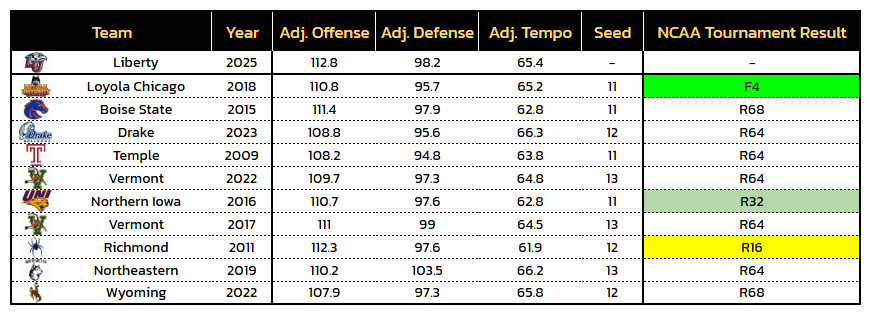
Liberty is keeping some pretty good company in terms of its efficiency profiles.
The Flames’ closest comparison, per Bart Torvik, is the 2018 Loyola Chicago team that went to the Final Four in a run that included some incredible late-game shots, and the list also includes the 2016 Northern Iowa squad that beat Texas on Paul Jesperson’s legendary half-court buzzer-beater. There’s also the 2011 Richmond group that beat Vanderbilt and Morehead State to make the Sweet 16 as a 12-seed.
If Liberty can live up to these comparisons, the Flames might wind up creating some of their own March Madness memories.
Tournament Index evaluation
As it stands, Liberty is a projected No. 12 seed by our bracketology at Heat Check CBB and on the Bracket Matrix. Compared to the 12-seeds that played in the past 10 first rounds, the Flames’ Tournament Index power rating is almost exactly average, grading out at 61.7 while the 10-year average is 61.9.
If they move up a line, their power rating would be lower than an all but seven No. 11 seeds since 2013; if they drop, the Flames would rate as the fourth-strongest No. 13 seed in that span. The TI projects an average of 0.42 wins for Liberty given its projected seed and strength.
You must be logged in to post a comment.