
After upsetting Central Connecticut in the Northeast Conference Tournament final, Saint Francis is headed to its first Big Dance since 1991.
The NEC was a two-horse race for much of this season. Central Connecticut largely ran the league, winning its last 12 regular-season games. Right on the Blue Devils’ tail was LIU, which went on two separate six-game winning streaks in league play. Those two were the favorites to win the conference tournament, but both were dispatched by the same foe: Saint Francis.
The Red Flash entered the NEC Tournament with a middle-of-the-pack 8-8 league record, but was coming off three consecutive wins. SFU had also beaten three of the four teams ahead of them in the standings, splitting its season series with LIU, Mercyhurst and Fairleigh Dickinson. In the conference tournament, Saint Francis exacted revenge for two regular-season losses to Wagner before beating LIU on the road to set up a third meeting with Central Connecticut.
The Blue Devils swept the regular-season series, and neither game was particularly close. CCSU won on the road by 15 and at home by 16, scoring a combined 157 points in the victories. In the championship, though, SFU’s defense prevailed in a grind-it-out 46-43 win to snatch the league’s automatic bid.
Saint Francis enters the NCAA Tournament on a six-game win streak but is just 13-17 against Division I opponents. The Red Flash are the fifth-lowest-rated NCAA Tournament team in the KenPom era, and the lowest since 2011.
More Heat Check CBB:
- Bracketology: Projected field | Bubble Watch
- Tournament Index: Complete March Madness projections
- Full conference tournament TV schedule
So…what changed? Possession control
Saint Francis was 7-17 against D-I competition just a couple of weeks ago and hadn’t won more than two games in a row all season. Now, the Red Flash are headed to the NCAA Tournament on a six-game win streak, the program’s longest since 2020.
So, what changed? Saint Francis has flipped the script in terms of possession advantage, reducing its own turnovers and ramping up its opponents’ giveaways.
The offense has dropped its turnover rate from 19.9 to 18.3 percent, while the the defense has raised its rate even more precipitously from 15.6 to 19.5 percent. Those improvements help make up a shot disparity that held SFU back: After being out-shot by 3.54 attempts per game over the first 24 contests, the Red Flash are averaging just 0.67 shot attempts fewer than their opponents over the last six games.
Considering that every win during the streak has come either in overtime or by precisely three points, this change on the margin is significant.
Riley Parker has been the driving force. The 6-2 junior led the team in scoring all year but has taken his game to another level down the stretch. During the streak, Parker has averaged 17.3 points, shooting an impressive 22-of-36 (.611) on 2-pointers and 15-of-35 (.429) on 3s, forming a strong inside-out punch with Valentino Pinedo. He has also keyed the Red Flash’s turnover turnaround, turning the ball over less frequently and more than doubling his steal rate over the last six games.
Between Parker, Chris Moncrief, Wisler Sanon and Bobby Rosenberger, the Red Flash have four rotation players posting steal rates of 2.9 percent or better since Feb. 16. For comparison, nobody was above 2.4 percent over the first 24 games.
Three-point shooting will be key
Saint Francis is 9-58 when it has shot below 33 percent from 3-point range over the last five seasons. This year, the Red Flash are 2-11 in that department — but they are 12-6 when they get up over 33 percent. Accordingly, the pressure is on Parker, as well as NEC All-Rookie honorees Juan Cranford and Jeremy Clayville, to be on form. Each has made at least 36.5 percent on at least 140 attempts.
Cranford, in particular, is riding a heater that earned him NEC Tournament MVP. He scored 45 points in the Red Flash’s three games, including a game-high 14 in the title win over Central Connecticut. After a brief adjustment period getting accustomed to the college level, Cranford has averaged 15.5 points on 39.7 percent 3-point shooting over SFU’s last 19 games, earning NEC Rookie of the Year along the way.
SFU’s offense ranks 300th in adjusted efficiency and sub-300 in turnover rate, offensive rebounding rate and free throw rate. For the Red Flash to win, they have to make shots. And with the 112th-highest attempt rate in the country, they need their 3s to drop. The backcourt duo of Parker and Cranford must be on their games to create space inside for Pinedo.
It wouldn’t hurt to have Clayville splash in a few off the bench, either. He averages one 3-point attempt for every 3.9 minutes he is on the floor, with 74 percent of his shots coming from distance for the year. Clayville’s 60 made threes trail only Parker (63) for the team lead.
Similar NCAA Tournament efficiency profiles
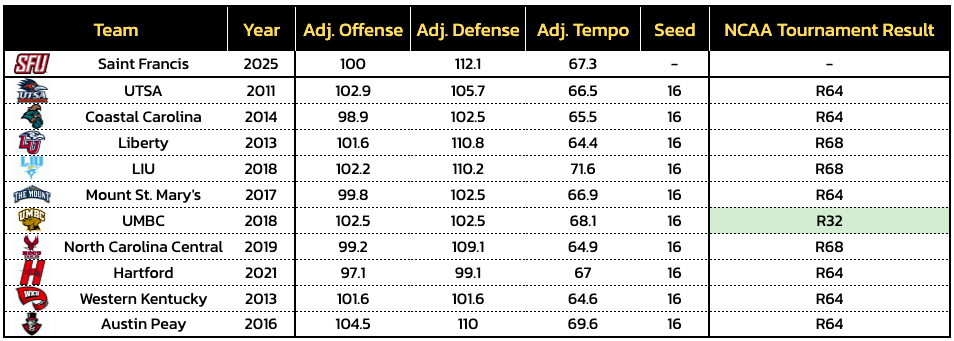
Tournament Index evaluation
As it stands, Saint Francis is a projected No. 16 seed by our bracketology at Heat Check CBB and on the Bracket Matrix. The Red Flash rate as the weakest No. 16 seed of the last 10 seasons (40 total No. 16 seeds) by the Tournament Index. That said, as shown above, one of their most similar efficiency profiles is that of 2018 UMBC, which became the first-ever No. 16 to beat a No. 1 seed.
The TI projects an average of 0.04 wins for Saint Francis given its projected seed and strength.
You must be logged in to post a comment.