
Tournament Index is here to help you through your March Madness bracket, including advice on your national champion, Cinderellas to pick, upset candidates and plenty more.
At long last, the 2023 NCAA Tournament bracket is finally here! It’s time to start crunching the numbers and gathering all the facts we need to know before making the final edits to our March Madness bracket selections.
To lend a hand, we are providing a complete guide through our Tournament Index NCAA Tournament projections to help sift through the madness. Tournament Index is Heat Check CBB’s official tournament projections model, and it has accurately predicted each of the last three national championships as well as key dark horses and upsets.
—Sign up for an HC+ subscription for all of our exclusive tournament coverage
—The only five teams that can win the 2023 national championship
—List of commentary teams for the 2023 NCAA Tournament
The guide below includes round-by-round win projections, dark horses, Cinderellas, upset picks, challenging tournament draws, under-seeded teams, and much more.
Without further ado, let’s dive into the madness.
Tournament Index “Best Value” Bracket
Note: These selections are subject to change based on nationwide pick popularity and will be updated routinely.
- Championship: Houston over Tennessee
- Final Four: Houston, Tennessee, Alabama, UCLA

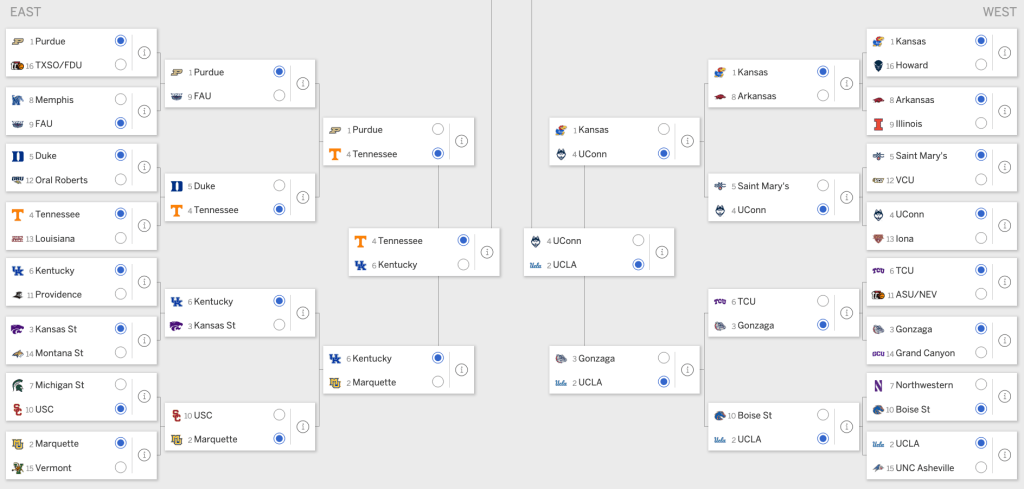
Tournament Index Bracket Projections 2023
| SEED | REGION | TEAM | BRACKET VALUE | POWER | PATH | R64 | R32 | S16 | E8 | F4 | NC |
|---|---|---|---|---|---|---|---|---|---|---|---|
| 1 | SOUTH | Alabama | 69.3 | 85.2 | 63.8 | 94.6% | 75.2% | 57.0% | 36.2% | 23.0% | 12.3% |
| 16 | SOUTH | A&M-CC/SEMO | 0.8 | 47.5 | 85.0 | 5.4% | 1.0% | 0.2% | 0.0% | 0.0% | 0.0% |
| 8 | SOUTH | Maryland | 9.8 | 67.6 | 73.1 | 51.3% | 12.4% | 5.7% | 1.9% | 0.6% | 0.1% |
| 9 | SOUTH | West Virginia | 9.3 | 66.7 | 72.6 | 48.7% | 11.4% | 5.1% | 1.6% | 0.5% | 0.1% |
| 5 | SOUTH | San Diego State | 21.1 | 70.6 | 67.5 | 66.9% | 36.5% | 12.6% | 4.9% | 1.9% | 0.6% |
| 12 | SOUTH | Charleston | 6.5 | 60.9 | 71.1 | 33.1% | 12.6% | 2.7% | 0.7% | 0.2% | 0.0% |
| 4 | SOUTH | Virginia | 20.8 | 71.4 | 66.4 | 73.2% | 41.9% | 15.0% | 6.1% | 2.5% | 0.8% |
| 13 | SOUTH | Furman | 5.1 | 57.4 | 70.9 | 26.8% | 9.0% | 1.7% | 0.3% | 0.1% | 0.0% |
| 6 | SOUTH | Creighton | 35.6 | 77.4 | 69.5 | 73.6% | 38.2% | 19.8% | 9.3% | 4.6% | 1.8% |
| 11 | SOUTH | NC State | 5.0 | 63.9 | 76.8 | 26.4% | 7.9% | 2.3% | 0.6% | 0.2% | 0.0% |
| 3 | SOUTH | Baylor | 44.3 | 78.8 | 66.8 | 85.6% | 50.9% | 28.0% | 14.1% | 7.4% | 3.1% |
| 14 | SOUTH | UC Santa Barbara | 2.2 | 54.8 | 78.1 | 14.4% | 3.0% | 0.6% | 0.1% | 0.0% | 0.0% |
| 7 | SOUTH | Missouri | 4.5 | 60.8 | 72.5 | 37.2% | 9.0% | 2.3% | 0.5% | 0.1% | 0.0% |
| 10 | SOUTH | Utah State | 15.3 | 67.3 | 67.3 | 62.8% | 21.2% | 7.7% | 2.6% | 0.9% | 0.2% |
| 2 | SOUTH | Arizona | 57.4 | 80.9 | 65.3 | 87.9% | 66.2% | 38.7% | 20.9% | 11.8% | 5.4% |
| 15 | SOUTH | Princeton | 2.2 | 54.7 | 79.6 | 12.1% | 3.6% | 0.6% | 0.1% | 0.0% | 0.0% |
| 1 | EAST | Purdue | 45.8 | 79.5 | 64.5 | 93.4% | 64.4% | 32.1% | 20.1% | 10.2% | 4.5% |
| 16 | EAST | Texas Southern/FDU | 0.8 | 43.5 | 79.4 | 6.6% | 0.9% | 0.1% | 0.0% | 0.0% | 0.0% |
| 8 | EAST | Memphis | 10.0 | 69.6 | 73.3 | 49.6% | 17.1% | 5.4% | 2.3% | 0.8% | 0.2% |
| 9 | EAST | FAU | 13.2 | 69.7 | 72.6 | 50.4% | 17.6% | 5.6% | 2.5% | 0.8% | 0.2% |
| 5 | EAST | Duke | 37.2 | 79.5 | 69.7 | 79.4% | 37.3% | 20.4% | 12.4% | 6.0% | 2.5% |
| 12 | EAST | Oral Roberts | 3.3 | 61.5 | 78.8 | 20.6% | 4.3% | 1.1% | 0.3% | 0.1% | 0.0% |
| 4 | EAST | Tennessee | 79.5 | 83.7 | 67.0 | 88.3% | 56.0% | 34.9% | 23.7% | 13.3% | 6.6% |
| 13 | EAST | Louisiana | 1.8 | 56.9 | 81.5 | 11.7% | 2.4% | 0.5% | 0.1% | 0.0% | 0.0% |
| 6 | EAST | Kentucky | 45.7 | 77.4 | 67.6 | 71.9% | 45.3% | 28.9% | 13.4% | 6.1% | 2.4% |
| 11 | EAST | Providence | 7.8 | 65.0 | 74.7 | 28.1% | 11.6% | 4.8% | 1.2% | 0.3% | 0.1% |
| 3 | EAST | Kansas State | 26.4 | 72.1 | 65.2 | 79.8% | 38.9% | 22.0% | 8.6% | 3.3% | 1.1% |
| 14 | EAST | Montana State | 3.2 | 53.2 | 72.1 | 20.2% | 4.1% | 1.1% | 0.2% | 0.0% | 0.0% |
| 7 | EAST | Michigan State | 10.8 | 64.3 | 68.3 | 48.9% | 20.2% | 7.3% | 2.0% | 0.5% | 0.1% |
| 10 | EAST | USC | 13.5 | 64.7 | 67.2 | 51.1% | 21.7% | 8.1% | 2.2% | 0.6% | 0.1% |
| 2 | EAST | Marquette | 26.2 | 72.8 | 64.4 | 80.3% | 52.0% | 26.5% | 10.7% | 4.3% | 1.5% |
| 15 | EAST | Vermont | 3.7 | 53.6 | 72.2 | 19.7% | 6.1% | 1.3% | 0.2% | 0.0% | 0.0% |
| 1 | WEST | Kansas | 33.6 | 81.7 | 68.6 | 92.2% | 58.0% | 32.7% | 15.5% | 7.6% | 4.0% |
| 16 | WEST | Howard | 1.0 | 47.9 | 81.6 | 7.8% | 1.0% | 0.1% | 0.0% | 0.0% | 0.0% |
| 8 | WEST | Arkansas | 22.9 | 78.1 | 75.6 | 61.2% | 27.4% | 13.2% | 5.1% | 2.1% | 0.9% |
| 9 | WEST | Illinois | 9.3 | 72.1 | 79.0 | 38.8% | 13.5% | 5.1% | 1.5% | 0.5% | 0.2% |
| 5 | WEST | Saint Mary's | 18.1 | 73.4 | 70.6 | 70.9% | 28.2% | 11.7% | 4.0% | 1.4% | 0.5% |
| 12 | WEST | VCU | 4.2 | 61.3 | 75.5 | 29.1% | 6.6% | 1.5% | 0.3% | 0.1% | 0.0% |
| 4 | WEST | UConn | 59.0 | 83.3 | 68.8 | 83.7% | 59.6% | 34.5% | 17.2% | 8.8% | 4.8% |
| 13 | WEST | Iona | 3.2 | 61.8 | 80.7 | 16.3% | 5.5% | 1.2% | 0.2% | 0.0% | 0.0% |
| 6 | WEST | TCU | 13.7 | 71.9 | 69.4 | 70.7% | 24.8% | 8.6% | 3.3% | 1.1% | 0.4% |
| 11 | WEST | Arizona St./Nevada | 4.4 | 60.2 | 75.2 | 29.3% | 5.8% | 1.1% | 0.2% | 0.0% | 0.0% |
| 3 | WEST | Gonzaga | 63.4 | 83.9 | 66.3 | 89.6% | 66.7% | 35.5% | 20.7% | 11.1% | 6.3% |
| 14 | WEST | Grand Canyon | 1.7 | 55.6 | 82.3 | 10.4% | 2.8% | 0.4% | 0.1% | 0.0% | 0.0% |
| 7 | WEST | Northwestern | 4.7 | 63.3 | 73.4 | 44.8% | 8.7% | 2.3% | 0.6% | 0.1% | 0.0% |
| 10 | WEST | Boise State | 9.0 | 65.7 | 70.2 | 55.2% | 12.4% | 3.7% | 1.1% | 0.3% | 0.1% |
| 2 | WEST | UCLA | 89.7 | 86.5 | 65.0 | 93.2% | 77.1% | 48.1% | 30.2% | 17.5% | 10.7% |
| 15 | WEST | UNC Asheville | 1.1 | 52.2 | 84.8 | 6.8% | 1.8% | 0.2% | 0.0% | 0.0% | 0.0% |
| 1 | MIDWEST | Houston | 115.8 | 89.5 | 63.7 | 95.2% | 77.6% | 60.6% | 44.3% | 27.7% | 18.3% |
| 16 | MIDWEST | Northern Kentucky | 0.7 | 51.1 | 89.2 | 4.8% | 0.9% | 0.2% | 0.0% | 0.0% | 0.0% |
| 8 | MIDWEST | Iowa | 5.3 | 66.3 | 77.2 | 39.0% | 6.8% | 2.7% | 0.9% | 0.2% | 0.1% |
| 9 | MIDWEST | Auburn | 14.0 | 71.9 | 72.7 | 61.0% | 14.7% | 7.4% | 3.2% | 1.0% | 0.4% |
| 5 | MIDWEST | Miami | 9.5 | 66.5 | 68.9 | 60.3% | 24.1% | 5.7% | 2.1% | 0.5% | 0.2% |
| 12 | MIDWEST | Drake | 7.0 | 60.4 | 69.8 | 39.7% | 12.3% | 2.2% | 0.6% | 0.1% | 0.0% |
| 4 | MIDWEST | Indiana | 33.5 | 76.5 | 67.1 | 76.7% | 53.8% | 19.7% | 10.4% | 4.2% | 1.9% |
| 13 | MIDWEST | Kent State | 4.9 | 60.5 | 74.6 | 23.3% | 9.8% | 1.6% | 0.4% | 0.1% | 0.0% |
| 6 | MIDWEST | Iowa State | 15.0 | 68.3 | 65.7 | 63.1% | 28.3% | 11.3% | 3.4% | 1.0% | 0.3% |
| 11 | MIDWEST | Mississippi St./Pitt | 7.5 | 61.2 | 69.5 | 36.9% | 12.3% | 3.5% | 0.7% | 0.1% | 0.0% |
| 3 | MIDWEST | Xavier | 34.3 | 74.2 | 62.2 | 84.3% | 55.2% | 27.9% | 10.8% | 4.2% | 1.8% |
| 14 | MIDWEST | Kennesaw State | 2.6 | 51.8 | 73.4 | 15.7% | 4.2% | 0.7% | 0.1% | 0.0% | 0.0% |
| 7 | MIDWEST | Texas A&M | 15.4 | 68.7 | 65.1 | 59.6% | 22.5% | 10.7% | 3.3% | 1.0% | 0.3% |
| 10 | MIDWEST | Penn State | 7.9 | 63.5 | 67.8 | 40.4% | 12.0% | 4.6% | 1.1% | 0.2% | 0.1% |
| 2 | MIDWEST | Texas | 46.8 | 80.3 | 65.8 | 87.2% | 62.0% | 40.4% | 18.7% | 8.8% | 4.5% |
| 15 | MIDWEST | Colgate | 2.3 | 54.9 | 79.2 | 12.8% | 3.5% | 0.8% | 0.1% | 0.0% | 0.0% |
Complete region projections
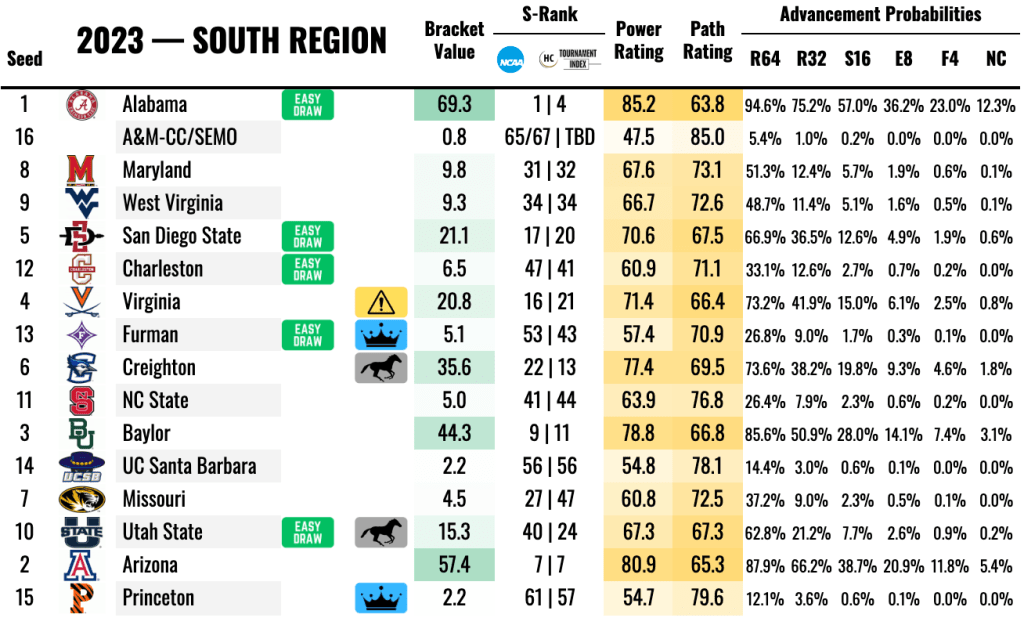


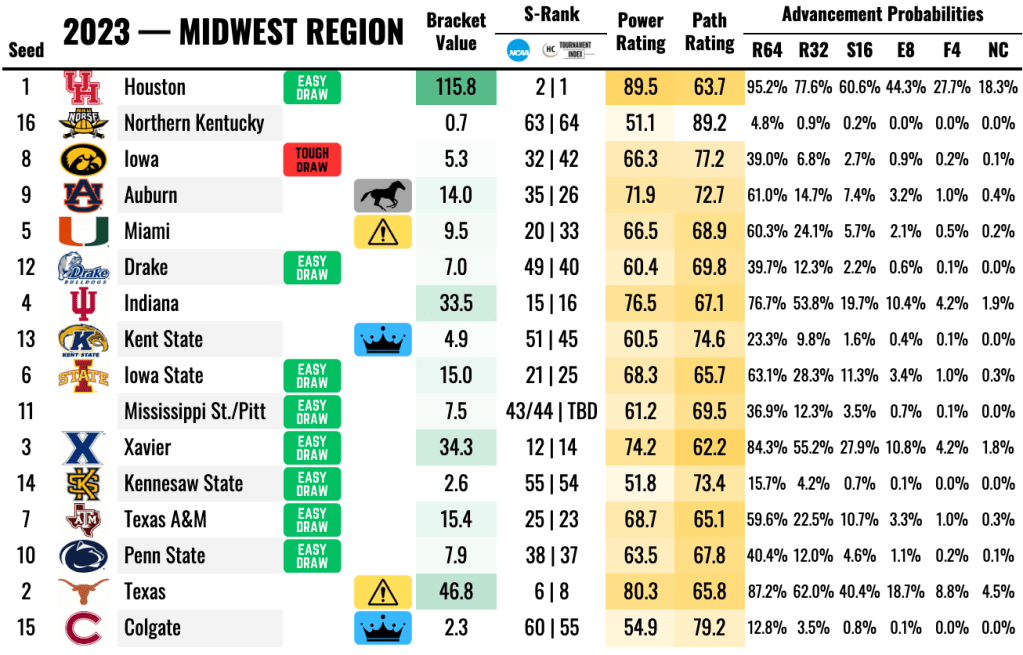
Alright, let’s start at the top. What’s the shakedown on the 1-seeds?
Alabama earned the top overall seed in the South region after a 29-5 regular season. The other 1-seeds are Houston (Midwest), Kansas (West) and Purdue (East).
Houston is the strongest of the 1-seeds, per our model. The Cougars’ 89.5 power rating is the 12th-highest in Tournament Index history, which dates back to 2013. The 11 teams ahead of Houston averaged 3.55 tournament wins; four reached the Final Four, nine reached the Elite Eight and all 11 made the Sweet 16. Kelvin Sampson’s teams have been often overlooked in recent years, possibly due to conference affiliation, but his last three March Madness appearances have resulted in an Elite Eight, Final Four and a Sweet 16.
Alabama isn’t too far behind with an 85.2 power rating, the third-best in the country behind only Houston and 2-seed UCLA. Both the Tide and Cougars benefit from favorable tournament draws and are poised for lengthy tournament runs.
Kansas and Purdue are on unsteady ground compared to their fellow top seeds. Kansas’ 81.7 power rating more closely resembles the average Tournament Index 3-seed (79.3 average power rating) and Purdue’s 79.5 power rating is nearly identical to the average 3-seed in our model.
While many pundits seem quick to pull the trigger on an early Boilermakers exit, the defending champs seem more likely for a brief tournament stay. Kansas was placed in an especially challenging West region, which features the likes of West Coast powers in Gonzaga and UCLA. More on that later.
Who are the national contenders that aren’t 1-seeds?
Overall, Houston has the highest national championship likelihood at 18.3 percent, per our model, with fellow 1-seed Alabama at 12.3 percent.
However, outside of the top seeds, 2-seed UCLA is the most likely national champion, with a 10.7 percent likelihood. Fellow contenders include 4-seed Tennessee (6.6%), 3-seed Gonzaga (6.3%) and 2-seed Arizona (5.4%). No other team has better than a 1-in-20 chance at winning it all.
Are there any teams that are over-seeded or under-seeded?
Yes, quite a few.
Utah State (plus-16), Kentucky (plus-13), Tennessee (plus-11), USC (plus-11), Arkansas (plus-11) and Furman (plus-10) are all slotted at least 10 spots higher on the Tournament Index 1-68 seed list than the NCAA’s list.
Missouri (minus-20), Northwestern (minus-18), Kansas (minus-12), Marquette (minus-10) and Iowa (minus-10) are all at least 10 spots lower on the Tournament Index 1-68 seed list than the NCAA’s list.
Which team is the scariest dark horse?
Seven teams have the Tournament Index “Dark Horse” tag beside their name in this year’s bracket. Let’s check out the most likely candidates.
Kentucky (6-seed): Kentucky is the seventh-strongest 6-seed in Tournament Index history and has the fourth-easiest tournament path as well. Combine these metrics, and it’s no wonder why the Wildcats are poised for a surprise March run. In fact, Kentucky’s 28.9 percent likelihood of reaching the Elite Eight is the highest probability ever for a 6-seed in our model’s history.
Despite the surprise ousting in the SEC Tournament to Vanderbilt, the Wildcats are still one of the more dangerous teams in the NCAA Tournament bracket. Kentucky is 14th nationally in adjusted offensive efficiency and is the second-best offensive rebounding team in the country, thanks to the mammoth inside in Oscar Tshiebwe. Placed in the East region that features the weakest 2-seed (Marquette) and 3-seed (Kansas State) in the bracket, Kentucky could do some serious damage after last year’s first-round upset to Saint Peter’s.
Which other teams could be dark horses?
Duke (5-seed): The Blue Devils enter their first NCAA Tournament of the post-Coach K era behind a nine-game winning streak and ACC Tournament title. Duke is a superb offensive-rebounding team and has upside (five Year 1 contributors) and NCAA Tournament experience (Jeremy Roach) on the roster. The draw certainly isn’t easy in the East region, but Jon Scheyer’s group has the potential to make a run with a 20.4 percent likelihood of reaching the Elite Eight.
Creighton (6-seed): A popular preseason breakout team, the Bluejays have recovered from a 6-6 start to the season with a 15-6 stretch since. Greg McDermott’s squad is balanced on both ends and could potentially face 3-seed Baylor and questionable defense in the second round. Creighton has a 19.8 percent chance at advancing to the Elite Eight, according to our model.
Arkansas (8-seed): It’s usually wise to avoid 8-seeds and 9-seeds when choosing a dark horse because 1-seeds are typically so strong. However, despite its youth, injuries and inconsistent play, Arkansas is a dangerous squad if it can hit its stride. The Razorbacks will look to muck it with their top-20 defense. If they can advance to play Kansas, it should be worth noting that the Jayhawks are 7-6 against top-20 defenses this year and 21-1 against everyone else.
Auburn (9-seed): Can a team just 7-9 over its last 16 games win in March? Certainly! Like Arkansas, Auburn comes from the smashmouth SEC where bruises are more common than made 3-pointers. How will Iowa, Auburn’s first-round opponent, handle that style of play? The Hawkeyes are one of the worst defensive teams in the entire tournament field.
Utah State (10-seed): The Mountain West is looking to put an end to its lengthy NCAA Tournament victory drought that dates back to 2019. Despite the loss to San Diego State, the Aggies are rolling into the field behind a stellar offense that ranks No. 13 nationally in adjusted efficiency. It helps, too, that its first-round opponent, Missouri, is vastly over-seeded, per Tournament Index.
USC (10-seed): The last time USC entered the tournament with a “Dark Horse” nod, it advanced to the 2021 Elite Eight as a 6-seed. Drew Peterson is still around from the 2021 team, providing valuable experience for the Trojans. Nothing comes easy against Andy Enfield’s squad, which ranks second nationally in 2-point percentage defense. A second-round date against Marquette, an over-seeded 2-seed, could spell upset.
What is the most likely upset pick?
Furman (13-seed) over Virginia (4-seed): Virginia still hasn’t won an NCAA Tournament game since cutting down the nets in 2019. The Cavaliers’ last three seasons ended in a tournament miss altogether, a first-round upset at the hands of 13-seed Ohio, and the 2020 tournament was canceled due to COVID-19.
Furman, meanwhile, is back in the dance for the first time since 1980. Bob Richey’s Paladins lead the entire country in 2-point percentage with an adjusted offensive efficiency over 40 spots better than Virginia’s, per KenPom. Virginia is 5-4 against opponents that rank in the top 100 in 2-point percentage offense this season and is 20-3 otherwise. Furman’s offense would rank third among ACC teams behind only Miami and Pitt.
We currently give Furman a 26.8 percent chance of pulling off the upset, comfortably higher than the Tournament Index first-round average of 18.1 percent for 13-seeds. If Virginia were to advance, it would almost certainly be a Vegas underdog against 5-seed San Diego State, so this is a relatively safe upset pick that won’t damage the rest of your bracket if Furman isn’t able to pull it off.
Who are the other upset candidates to monitor?
Drake (12-seed) over Miami (5-seed): Miami earned a 5-seed as the selection committee’s No. 20 overall team compared to Drake at No. 49. Our metrics have this one much closer, however, with Miami at No. 33 and Drake No. 40 — far more similar to a 7/10 matchup than a 5/12.
Led by head coach Darian DeVries’ son Tucker, the Bulldogs have a 39.7 percent chance of pulling an upset, compared to the 29.7 percent average for 12-seeds on Tournament Index. Miami’s defense ranks 132nd on KenPom, better than only 15 tournament teams, many of which are 15-seeds and 16-seeds.
Vermont (15-seed) over Marquette (2-seed): Marquette enters the Big Dance as one of the sport’s biggest surprises, climbing from lowly preseason projections to the Big East regular-season and tournament titles. But could the fun end here? The Golden Eagles enter their matchup against Vermont as the weakest 2-seed in Tournament Index history.
With a 72.8 power rating, Marquette more closely resembles the average Tournament Index 6-seed, which has an average power rating of 72.4. Breakout stories typically go awry once March Madness comes around, especially for a team with lacking size, spotty defense, and no bonafide pros.
Colgate (15-seed) over Texas (2-seed): While Texas is a below-average 2-seed according to our model, this upset bid has far more to do with the Longhorns’ tournament draw. Colgate is one of the stronger 15-seeds in recent memory, thanks in large part to a high-powered offense that ranks tops nationally in effective field-goal percentage.
Matt Langel’s Raiders have been here before. This is the program’s fourth-consecutive NCAA Tournament appearance. The previous three tournaments include a one-possession game with two minutes left in 2019 vs. 2-seed Tennessee, a 14-point lead over 3-seed Arkansas in 2021, and a four-point deficit vs. 3-seed Wisconsin last year with three minutes left.
Howard (16-seed) over Kansas (1-seed): Now is an appropriate time to advise readers that it’s unwise to pick against every team on Tournament Index‘s “Upset Alert.” However, “Upset Alert” tags for top-seeded teams are often indicative that a lengthy tournament run is unlikely — examples include 2022 Arizona (needed OT in the second round), 2018 Xavier (second-round loss) and 2014 Wichita State (second-round loss).
Kansas isn’t a particularly strong 1-seed, per our model (81.7 power rating vs. 87.1 average for 1-seeds). Howard is an alarming turnover machine on offense, but the Bison make up for it with solid shooting numbers and second-chance opportunities. At the end of the day, though, it’s still a hugely unlikely upset bid.
Is there a Cinderella to watch?
Vermont (15-seed): The Catamounts are back in the Big Dance for the fourth time since 2017. John Becker’s team can shoot the lights out and takes excellent care of the basketball.
Tournament Index gives UVM a 19.7 percent chance to upset 2-seed Marquette — the highest probability of a 15-over-2 upset in our model’s history. Marquette is the weakest 2-seed in Tournament Index history with a power rating of 72.8 and Vermont is an above-average 15-seed as well. Are the Catamounts the next 15-seed to shock the world? Our model doesn’t see it as a surprise.
Who are the other potential Cinderellas?
Kent State (13-seed): Can Rob Senderoff’s group send Indiana packing? Behind a stingy defense and elite perimeter defender in Malique Jacobs, the Golden Flashes will try to make life miserable on star Hoosier freshman Jalen Hood-Schifino. Our model gives Kent State a 23.3 percent chance of pulling off the first-round upset.
Furman (13-seed): Furman enters the Big Dance having won 14 of its last 15 games behind a high-powered offense, including studs Mike Bothwell and Jalen Slawson. Virginia is already on “Upset Alert” based on our model’s projections, and Furman is slotted 10 seeds lower on the NCAA seed list than the Tournament Index seed list.
Princeton (15-seed): Could Princeton pull off the unthinkable against Arizona? Mitch Henderson’s squad is an above-average 15-seed with a power rating of 54.7, compared to the average of 52.6 for 15-seeds. Princeton’s calling card is the defensive glass, which is good news when facing up against one of the country’s best frontcourts in Arizona’s Azuolas Tubelis and Oumar Ballo.
Colgate (15-seed): The country’s best shooting team based on effective field-goal percentage, Matt Langel’s Raiders are in their fourth consecutive Big Dance and will hope the fourth trip results in an upset bid after a handful of close calls. Its first-round opponent, Texas, is led by interim head coach Rodney Terry. The Longhorns have an abundance of talent and experience but Terry only has 40 minutes of tournament experience, reaching the Big Dance in 2016 with Fresno State.
Who has the easiest draw?
Xavier. In fact, it’s the easiest tournament path in Tournament Index history! The 3-seed Musketeers received a gift from the selection committee with a 62.2 path rating, which measures the difficulty of a team’s path throughout the course of the tournament. To put the number into further context, the average path rating for a 1-seed is 66.0, 2-seed is 66.3 and 3-seed is 67.2.
Xavier’s first-weekend pod in the Midwest region includes this year’s weakest 14-seed in Kennesaw State as well as the weakest 6-seed (Iowa State) and the winner of Mississippi State and Pitt, both of which are below-average 11-seeds according to our model. Additionally, 2-seed Texas is an “Upset Alert” as mentioned above. This region could absolutely break to Xavier’s benefit.
Other favorable draws to monitor: Vermont (15-seed), Texas A&M (7-seed), USC (10-seed), Utah State (10-seed) and Drake (12-seed)
Who has the toughest draw?
The selection committee did Kansas zero favors. After last year’s team had the easiest draw among the 1-seeds, the 2023 Jayhawks are faced with a much bigger obstacle. Despite the 1-seed, Kansas’ path difficulty rating ranks 23rd overall in the entire bracket. Shockingly, three 10-seeds (USC, Utah State and Penn State) all have more favorable draws compared to Bill Self’s squad.
Not only does Kansas have to travel far to the West region, it potentially has to face either the strongest 8-seed (Arkansas) or 9-seed (Illinois) in the second round and could face either the second-strongest 4-seed (UConn) or 5-seed (Saint Mary’s) if it survives the first weekend. Naturally, the West’s 2-seed, UCLA, is also the strongest 2-seed in this year’s bracket as well. Ouch.
Other unfavorable draws to monitor: Illinois (9-seed), Iowa (8-seed), Oral Roberts (12-seed), Grand Canyon (14-seed) and Louisiana (13-seed)
Which teams provide the best value in my bracket pool?
Great question. The best way to get ahead of the competition in your bracket is to identify teams capable of making deep runs that others may overlook.
The top 10 value picks include Kentucky, Vermont, Tennessee, Arkansas, Creighton, Utah State, Auburn, USC, Florida Atlantic and Gonzaga. Each of these teams is projected to pick up significantly more bracket points than their typical seed would be expected to earn in this year’s tournament.
Are there any extreme seeds?
Yes, plenty.
- Purdue is the third-WEAKEST 1-seed ever
- Marquette is the WEAKEST 2-seed ever
- Kansas State is the second-WEAKEST 3-seed ever
- Virginia is the third-WEAKEST 4-seed ever
- Miami is the WEAKEST 5-seed ever
- Missouri is the WEAKEST 7-seed ever
- Arkansas is the third-STRONGEST 8-seed ever
- Iona is the third-STRONGEST 13-seed ever
- Kennesaw State is the third-WEAKEST 14-seed ever
Who should I pick to win it all?
The value is with Houston. To win a bracket pool, you have to zig while everyone else zags, and the best chance of earning the most points compared to your competitors is to select the Cougars to win it all.
In 2019, the general population leaned heavily toward Duke as 36.1 percent of ESPN Tournament Challenge users picked the Blue Devils. Virginia, with 8.4 percent of selections, won it all.
In 2021, Gonzaga (34.4%) was the overwhelming favorite, yet it was Baylor (10.4%) that took home the title.
Last year, Gonzaga (27.1%) was the choice again. Kansas (8.3%) cut down the nets.
At the time of this writing, Alabama is the heavy favorite as the top overall seed. The smart money says to pick Kelvin Sampson and the Cougars to get the job done.
You must be logged in to post a comment.